
- Navigate the table of contents by selecting any section to jump directly to that part of the article.
- To add interactions which automatically expand and collapse sections in the table of contents select the content27_h-trigger element, add an element trigger and select Mouse click (tap)
- Click any heading in the table of contents to expand or collapse detailed information within that section.
- On mobile devices, the table of contents remains visible but interactions are disabled to ensure smooth scrolling.
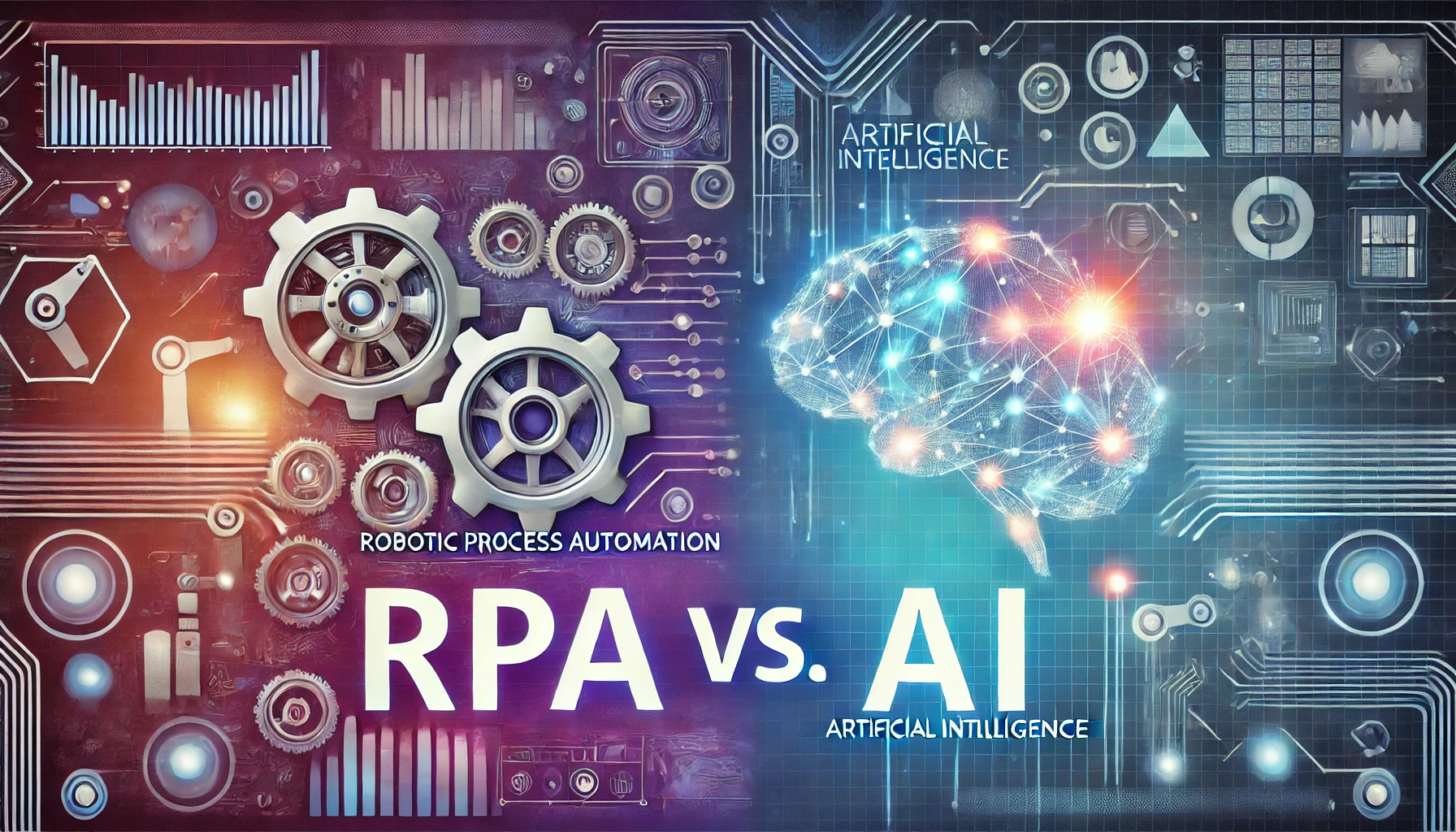
Discover the key differences between Artificial Intelligence (AI) and Robotic Process Automation (RPA). While both technologies transform business processes, they serve distinct purposes. Learn how AI goes beyond automation to adapt and innovate, while RPA excels in rule-based tasks. Which solution fits your organization best?
AI and RPA: Two forces transforming the digital workplace
In the ever-evolving world of technology and automation, Artificial Intelligence (AI) and Robotic Process Automation (RPA) often dominate discussions. While both are critical in optimizing business processes, they serve entirely different purposes. You might wonder: “Isn’t AI just a smarter version of RPA?” or “Is RPA only for simple tasks?” The reality is more nuanced. Let’s dive into these digital powerhouses to uncover their unique strengths and determine which one suits your organization best.
What is AI? The intelligent thinker that goes beyond automation
AI is the technology that learns, anticipates, and adapts. Where RPA follows a script, AI takes decisions autonomously. It identifies patterns, predicts outcomes, and offers creative solutions to complex problems—even in unexpected situations.
For example, imagine an AI-powered chatbot that not only answers questions but continuously improves its responses by learning from each interaction. Or AI leveraging machine learning to forecast trends and provide strategic insights that drive your business forward. AI adds intelligence to automation, making it a game-changer for more intricate workflows.
However, AI comes with its challenges. Developing and implementing AI requires time, resources, and—most importantly—data. Without sufficient information, AI is like a student without textbooks. That’s why, at Freeday, we believe in creating a centralized AI knowledge base where skills are continuously refined for maximum impact.
What is RPA? The invisible hero of repetitive tasks
RPA (Robotic Process Automation) excels at rule-based, repetitive tasks. It takes over actions within a system’s graphical user interface (GUI), making it especially useful for legacy environments where API integrations aren’t possible, such as AS400 or green screens.
RPA is highly effective for standardized processes but struggles when faced with change or unpredictability. Think of RPA as a highly skilled athlete performing the same routine flawlessly but stumbling when improvisation is required. This rigidity often leads to higher maintenance costs, making it less scalable in dynamic environments.
The core difference: Automation vs. intelligence
The key distinction lies in their functionality:
- RPA automates simple, predictable tasks by following strict rules.
- AI mimics human intelligence, handling dynamic, unstructured data and adapting as it learns.
RPA is perfect for straightforward processes like data entry, while AI thrives in scenarios requiring interpretation and decision-making, such as analyzing text, images, or audio.
When does AI shine?
AI is indispensable in scenarios that require:
- Dynamic decision-making: For instance, fraud detection in finance or predicting patient risks in healthcare.
- Personalized customer experiences: AI can go beyond basic product recommendations by considering customer behavior, preferences, and even emotional tone.
With AI, businesses unlock insights and deliver experiences that exceed expectations.
Why Freeday doesn’t use RPA
At Freeday, we exclusively rely on Generative AI, machine learning, and logic-based engines. We’ve found that 99% of processes can be solved with API integrations or other direct connections, offering greater robustness and scalability compared to RPA.
Our digital employees specialize in external interactions, internal operations, and knowledge-intensive tasks such as Accounts Payable and Customer Due Diligence. These processes require the ability to manage unstructured data and complex workflows—precisely where AI excels.
Explore more workforce insights
Read how enterprises across industries deploy digital employees to transform operations.




FAQ
Common questions about AI agents, automation, and enterprise deployment answered.
AI agents handle repetitive workflows continuously without fatigue or error, eliminating the need for proportional headcount increases. Enterprises using Freeday reduce contact center costs by up to 92% while maintaining industry-leading CSAT scores. The agents process one million monthly calls with consistency that human teams cannot match, handling customer service inquiries, KYC verification, accounts payable processing, and healthcare intake simultaneously across voice, chat, and email channels.
Any workflow that follows consistent rules and doesn't require complex human judgment can be automated. This includes customer service inquiries, KYC verification, accounts payable processing, patient intake, appointment scheduling, booking modifications, returns management, and insurance verification. The platform connects to over 100 business applications including Salesforce, SAP, and Epic, enabling agents to access the systems your organization already uses.
Freeday maintains ISO 27001 certification with full GDPR and CCPA compliance built into the platform foundation. Security and governance requirements are not afterthoughts but core architectural principles. Your customer data and business processes receive protection that matches the sensitivity of the information involved, with enterprise-grade controls for organization-wide AI deployment.
Performance Intelligence tracks conversation metrics and auto-scores CSAT in real time, detecting issues before escalation becomes necessary. The system provides visibility into what agents are doing, why they're making decisions, and whether they're complying with regulations. This eliminates manual reporting that consumes time and introduces errors.
Freeday's architecture supports any AI model, protecting your investment as technology evolves. You're not locked into a single vendor's approach and can experiment with different models to choose what works best for your specific workflows. This flexibility ensures your platform remains current as the AI landscape changes.
Ready to learn more?
Reach out to our team to discuss your specific needs.