
- Navigate the table of contents by selecting any section to jump directly to that part of the article.
- To add interactions which automatically expand and collapse sections in the table of contents select the content27_h-trigger element, add an element trigger and select Mouse click (tap)
- Click any heading in the table of contents to expand or collapse detailed information within that section.
- On mobile devices, the table of contents remains visible but interactions are disabled to ensure smooth scrolling.
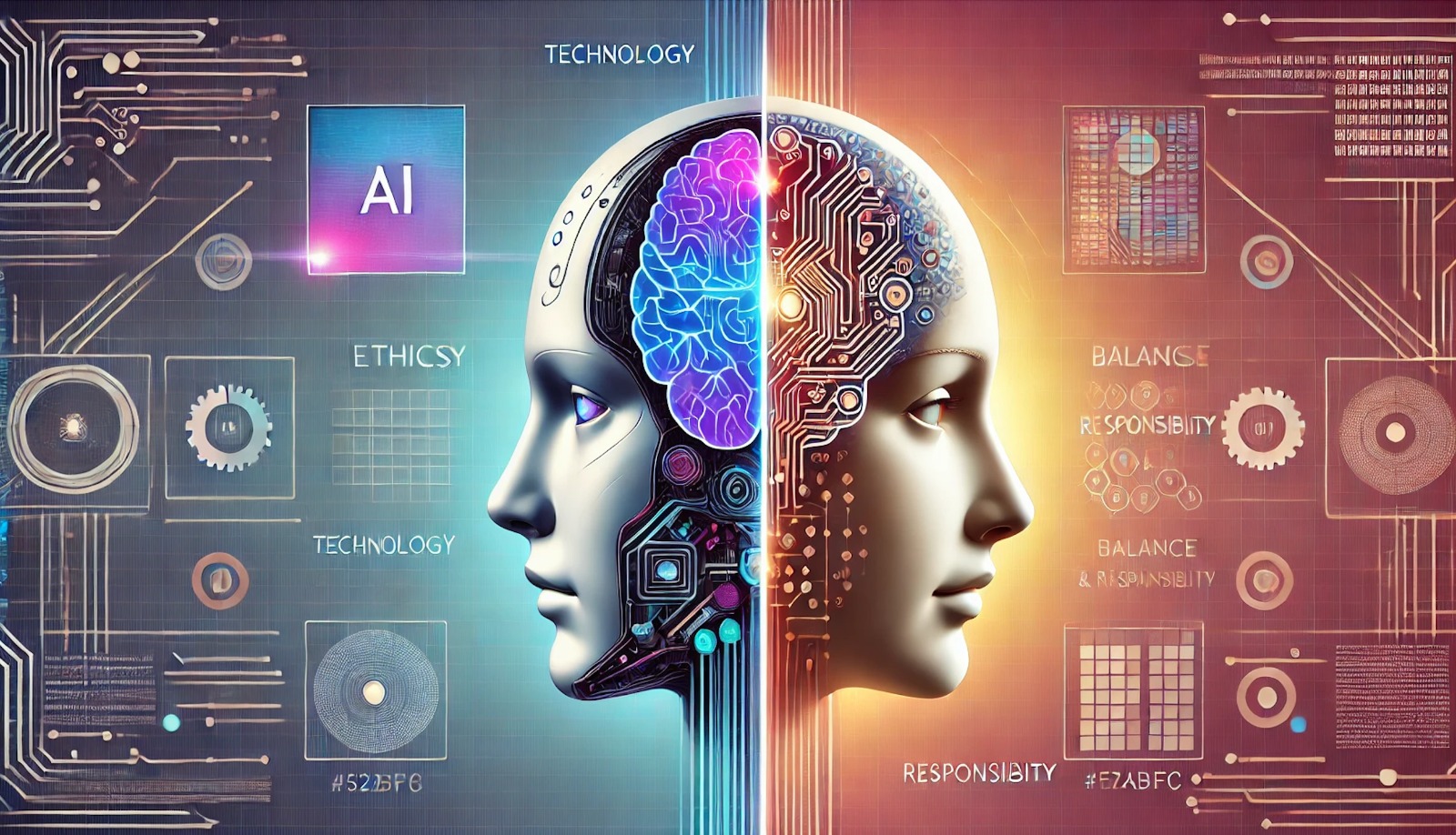
The rise of artificial intelligence (AI) has significantly transformed how we work, live, and communicate. As AI continues to evolve, it brings both exciting opportunities and important ethical challenges that need to be addressed responsibly by businesses and society alike.
1. AI and bias: where do we draw the line?
One of the most discussed ethical issues surrounding AI is bias in AI systems. AI is trained on historical data, which means it can inherit the biases inherent in that data. Think of discrimination based on gender, race, or social background. Big tech companies are trying to correct these biases, but the question remains: how far should we go? Should we erase historical biases or only intervene with new content?
Bias in AI is a serious issue, especially in sensitive sectors like finance and law, where decisions based on skewed data can have devastating consequences for individuals.
Companies need to be clear about how they address bias and be transparent about their correction mechanisms.
2. AI and employment: will AI replace us?
A common concern is that AI will take over human jobs. Will we all be unemployed soon? AI is increasingly used in sectors like customer service, creative work (such as design, marketing, coding), and even therapy. This raises the question: is it ethical to allow AI to take over jobs that people find enjoyable and meaningful?
At Freeday, we don’t see AI as a replacement for human labor but as a way to take over repetitive tasks.
This gives employees the space to focus on more complex and challenging tasks, which are often seen as energizing and valuable. AI isn’t meant to eliminate jobs but to make work more interesting and fulfilling.
3. AI as a manipulation tool
AI can be used to deceive or even manipulate people. Think of refined versions of the classic "Nigerian Prince" scams or personalized, targeted messages attempting to influence individuals. How do we prevent AI from being misused to deceive people?
Companies must proactively establish ethical guidelines for AI use, including preventing malicious applications. Transparency and educating users about how AI approaches them, and its boundaries, can help prevent misuse.
4. Data ownership: who owns the data?
AI is trained on vast amounts of data, but who owns that data? Is it ethical to use data to generate profits? This question touches on the core of privacy and ownership rights in the digital world.
For companies like Freeday, it’s essential to be transparent about data usage. In the EU, strict data privacy rules, such as the GDPR, require companies to handle personal data carefully. Data collection should only occur with the user’s consent, and companies must be cautious about storing unnecessary data.
5. Transparancy: how can companies make their AI systems more understandable?
Transparency is crucial to earning user trust. This means companies must clearly explain how their AI systems work, what data is used, and how decisions are made. Users should know when they are interacting with AI rather than a real person. This not only prevents a sense of deception but also helps bridge the gap between technology and humans.
At Freeday, we ensure users always know when they’re dealing with AI, and we offer insight into how our systems operate. While some users may not need detailed explanations, for others, access to documentation and blogs that explain AI’s workings is important.
6. The challenges of ethical AI implementation
For companies, there’s often no clear guideline on what’s ethically right. What is considered ethical, and who decides that? This largely depends on the AI application. For example, an AI model used for financial decisions must be accurate and impartial, while a conversational AI must ensure that language differences or spelling don’t affect the quality of the responses. Additionally, there’s the fear that AI will replace human jobs.
Employees actually welcome AI assistance, as it frees them from monotonous tasks and allows them to focus on challenging, valuable work.
7. The impact of privacy legislation on AI use
EU privacy legislation, such as GDPR, has a significant impact on how companies can use AI. These laws provide clear guidelines and boundaries, eliminating any uncertainty about what is acceptable. At Freeday, we always stay on the safe side of these rules, helping us develop ethical AI solutions that earn the trust of our customers and users.
8. Freeday's approach to ethical AI
At Freeday, we approach AI carefully and ethically. We don’t use live data to train models, as this is difficult in a privacy context. Instead, we build AI solutions with smaller modules that work together to deliver powerful results, all while maintaining full control over the process. Critical decisions are always made by humans, while AI automates the repetitive tasks.
We ensure a future where AI not only enhances efficiency but also makes a positive contribution to society.
Explore more workforce insights
Read how enterprises across industries deploy digital employees to transform operations.




FAQ
Common questions about AI agents, automation, and enterprise deployment answered.
AI agents handle repetitive workflows continuously without fatigue or error, eliminating the need for proportional headcount increases. Enterprises using Freeday reduce contact center costs by up to 92% while maintaining industry-leading CSAT scores. The agents process one million monthly calls with consistency that human teams cannot match, handling customer service inquiries, KYC verification, accounts payable processing, and healthcare intake simultaneously across voice, chat, and email channels.
Any workflow that follows consistent rules and doesn't require complex human judgment can be automated. This includes customer service inquiries, KYC verification, accounts payable processing, patient intake, appointment scheduling, booking modifications, returns management, and insurance verification. The platform connects to over 100 business applications including Salesforce, SAP, and Epic, enabling agents to access the systems your organization already uses.
Freeday maintains ISO 27001 certification with full GDPR and CCPA compliance built into the platform foundation. Security and governance requirements are not afterthoughts but core architectural principles. Your customer data and business processes receive protection that matches the sensitivity of the information involved, with enterprise-grade controls for organization-wide AI deployment.
Performance Intelligence tracks conversation metrics and auto-scores CSAT in real time, detecting issues before escalation becomes necessary. The system provides visibility into what agents are doing, why they're making decisions, and whether they're complying with regulations. This eliminates manual reporting that consumes time and introduces errors.
Freeday's architecture supports any AI model, protecting your investment as technology evolves. You're not locked into a single vendor's approach and can experiment with different models to choose what works best for your specific workflows. This flexibility ensures your platform remains current as the AI landscape changes.
Ready to learn more?
Reach out to our team to discuss your specific needs.